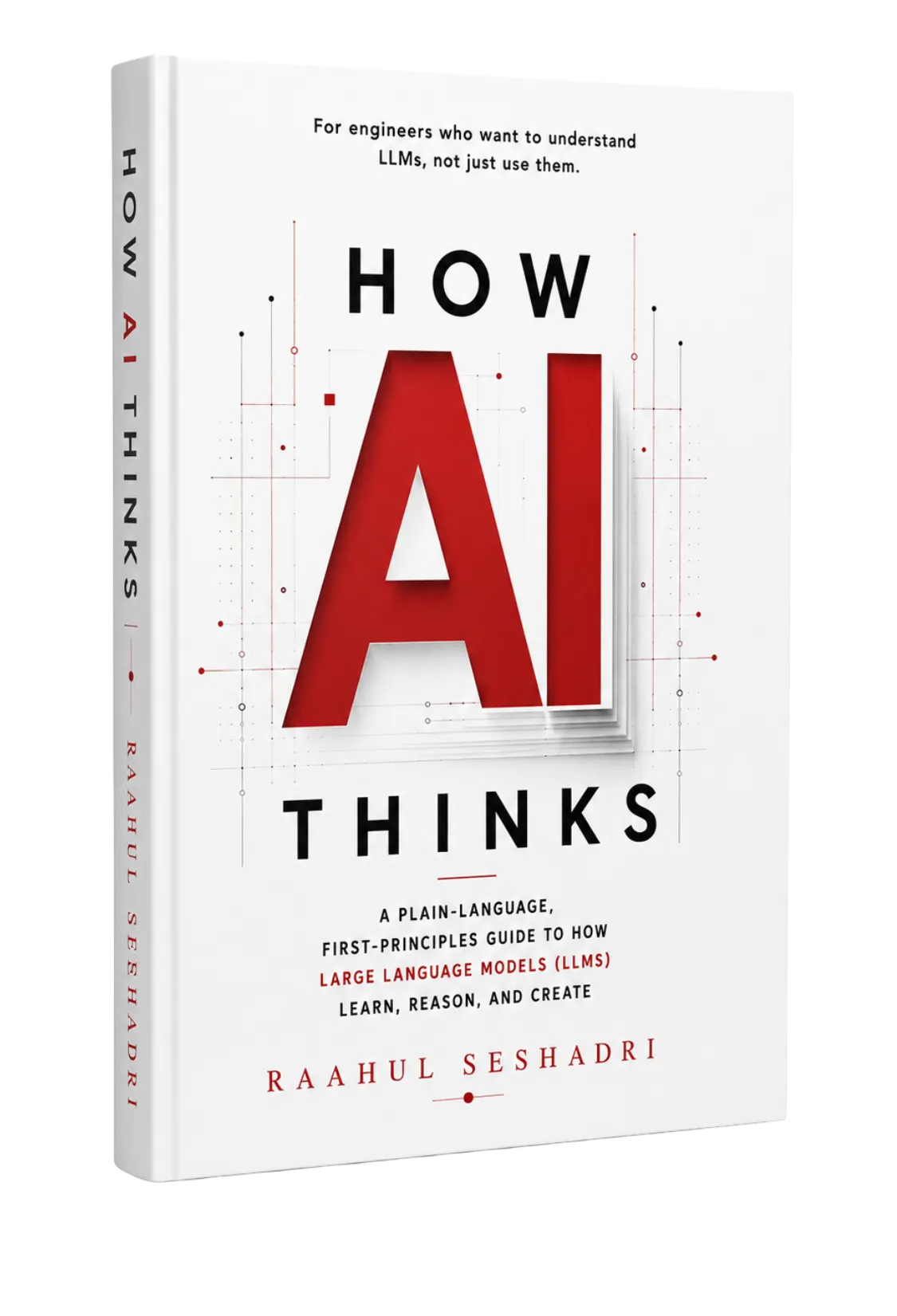
A fundamentals-first guide for engineering leaders who want clarity before committing to bets.
AI is entering production faster than engineers can understand it. It doesn’t fail like software. There’s no debugger, no obvious point of failure. You’re shipping blind. This book gives you the mental models to see inside the black box and make real decisions about LLMs.
Get the BookBy Raahul Seshadri
You won’t just “know more about AI.” You’ll be able to reason about it.
Not every problem should be solved with AI. You’ll gain the intuition to tell the difference before you build the wrong thing.
Instead of trial and error, you’ll understand why certain prompts work, why others fail, and why outputs vary.
Not just that they happen, but why they happen, and which kinds of problems make them more likely.
You’ll see how LLMs can appear to reason, what that means mechanically, and where that illusion breaks down.
You’ll be able to think in terms of inputs, constraints, failure modes, and tradeoffs. The same way you do with any other system.
Without hand-waving. Without hype. Without pretending it’s magic.
A chapter-by-chapter breakdown of what you'll learn.
What words like intelligence, learning, and reasoning actually mean when applied to machines, and why most debates about AI start with bad definitions.
The core principle behind every language model, explained simply: what the model is really optimizing for and how that turns into useful behavior.
What LLMs actually operate on (tokens and numbers), how they represent relationships between words, and why meaning is something we add—not the model.
How massive amounts of text turn into behavior, why training takes so much compute, and what the model really learns from data.
Where randomness comes from, how decoding works, and why variability is a feature and not a bug.
Why the same mechanism that makes models creative also makes them wrong, and how to reason about that tradeoff.
What’s actually happening when a model solves a problem, what it can and can’t do reliably, and where the illusion of reasoning breaks down.
This book is for technical and product leaders who need clear mental models of AI, instead of hype, buzzwords, or cargo-cult explanations.
Senior leaders responsible for technical direction who need to reason clearly about what AI is and is not before making bets.
Leaders managing teams building with or around LLMs who need accurate intuition to guide decisions and expectations.
Senior engineers responsible for designing systems that incorporate LLMs.
Builders using LLMs as core technology who need clarity before scaling ideas, teams, or narratives.
Managers of ML or data teams who want a deeper explanation of model behavior beyond surface-level explanations.
Product managers and directors working with AI-powered features.
This book won't be the right fit if you're looking for quick fixes or surface-level answers.
People looking for step-by-step tutorials or prompt recipes won't find them here. This book teaches the why, not the how.
Readers who want hype, futurism, or AGI speculation won't find it here. This book is grounded in reality, not marketing.
Teams seeking implementation patterns without understanding fundamentals won't find shortcuts. This book requires thinking.
This book is about thinking clearly, not shipping faster.
I specialize in designing and architecting complex AI systems. As of early 2026, I lead AI for a major SaaS product—setting the vision, inventing frameworks, and packaging them into a wonderful product experience.
My background: I've been programming since the age of 11 (almost 25 years). I'm an undergraduate in Electronics & Telecommunications Engineering and hold a Master's in Computer Science from GeorgiaTech, specializing in Machine Learning.
Over the years, I've architected complex high-scale systems, led big teams, designed differentiators, and seen how business & technology intertwine behind closed room meetings with prominent leaders.
In writing this book, I combine my AI knowledge with my first-principles thinking approach—putting everything in the context of the business of technology so what I cover is both clear and useful.
Choose the right option for you or your team
Perfect for personal learning
For teams and organizations
Common questions about the book, what you'll learn, and who it's for